2nd grade

Hundred Board Number Puzzles

Monday, April 04, 2016


Hi Friends! I am dropping in quickly to share some freebies with you from one of my FAVORITE enrichment activities! I hope it is of help to you and your little geniuses!

I use Hundred Board Enrichment Puzzles to challenge my 2nd and 3rd grade students. I am in love with these puzzles because they are both FUN and MEANINGFUL. Each puzzle offers an interesting, non-routine way to develop important math concepts and critical thinking skills.

So, how do they work? Each Hundred Board puzzle provides a series of 4-6 mathematical clues. Students use the clues to determine the value of the mystery number. While the focus of each activity is numeracy, each puzzle includes a variety of upper elementary math skills, concepts, and vocabulary.

Here's an example from the 2nd grade pack:


Puzzle #8:
  • It is greater than the number of years in a decade.
  • It does not contain the digit that equals the number of sides on a rhombus.
  • It is not between the value of 4 nickels and 4 dimes.
  • The digit in the ones place = the number of inches in ½ a foot.
  • The sum of the digits is < 11. 

As you can see, the focus is on numbers and operations, yet students also need to apply geometry, measurement, time, and academic math vocabulary in order to solve this puzzle.

Here's an example from the 3rd grade version:

Puzzle #5:
  • The number is greater than the number of sides on a trapezoid.
  • The mystery number is less than the perimeter of a 6 by 6 array.
  • None of the digits are even.
  • The sum of the digits equals 8.
Again, the focus is on numbers and operations, but students also need to apply geometry, measurement, and perimeter in order to solve this puzzle. Fun, right!

There are 20 puzzles in each pack and the level of complexity increases as the puzzle number gets higher.

The puzzles come in color and black and white, so I can use them in a variety of ways. Some of my favorite uses include:
  • math centers and stations 
  • a printable packet for early finishers 
  • anchor activities 
  • learning contracts 
  • choice board activities 
You can download both of the activities shown above for free by clicking on the link below the image. I hope you are your students enjoy them as much as mine!

brain food

Let's Interact - Halloween Style!

Saturday, October 03, 2015


I am super excited about my latest Interactive Bulletin Board! Check out my October-themed board and grab a few freebies below.


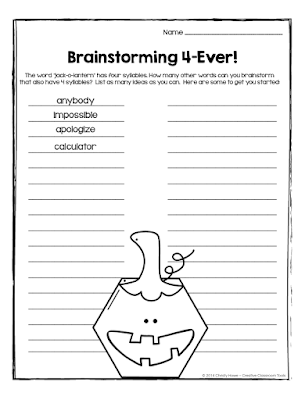
First up on the board is "Brainstorming 4-Ever!" This was originally a printable activity I used as an anchor activity with my little Einsteins. This year, I decided to make the activity larger than life to "hook" and motivate my students in a new way.

Using the word "Jack-o-lantern" as inspiration, this Halloween-themed activity challenges students to think of as many different 4-syllable words as they can. Avocado, comprehension, impossible, articulate . . . the possibilities are endless, but it is delightfully difficult!

To add a level of difficulty, eliminate proper nouns. OR, make it a game! After brainstorming a list of words, students compare answers with other players. Students earn one point for each unique response that no other player has. The player with the most points wins. This can be timed or un-timed.

When students arrive to class early, finish assignments early, are in need of enrichment, or just want to be inspired, they grab a brainstorming sheet from the envelope. I've included a printable copy of the activity below in case you'd like to try it out with your kiddos. :-)

You can find the whole pack of activities here.

Next up, is Halloween math:


This too was a printable activity that I enlarged for a new twist. Each Halloween symbol represents a number. Students can "Guess and Check" or use algebra to reach the correct answer. There is something about a larger than life math problem that kids love! I'm not sure if it's the novelty of the presentation or the seasonal images, but they are in love. You can find the printable version of this activity (along with the answer :-) here.

And last, but not least, is 24 - an all-time student favorite.


In the game of 24, students use the four numbers given once and only once along with a combination of operations to reach 24. Students record their answer on the recording sheet below. You can find a free copy here. (It's nothing fancy, but it's one less thing to make :-)


24 is so easy to prep and offers meaningful, fun, differentiated math practice. If you'd like to learn more, you can check out my earlier post here.

Thanks for checking in! If you have any thoughts or questions, let me know; I'd love to hear from you!

5th grade

Let's Interact!

Thursday, April 02, 2015

Prior to spring break, I set up an interactive bulletin board for my 3-5 students. I have a small classroom, so my goal was to maximize our space and use the bulletin board as a teaching tool. So far, it's been great! My students race to class to check out and solve the new challenges!

As of now, it contains three activities, which change every week or two. The activities are meaningful and low maintenance, which I love, and highly engaging, which my students love. Read on to learn more (and grab a couple of freebies!)


Going from left to right, the first activity on the board is Decimal Detectives. Every week or so, I post a new set of clues; students use the clues to determine the mystery decimal.


Once students solve the riddle, they record their answer on one of the recording sheets pictured below.


They submit their answer to me as a "ticket" and we draw weekly (or bi-weekly depending on what kind of week it is :-) for a winner. The prize is usually something silly like a pencil or "partner pass," but my students love to be recognized - and recognize others - for their effort. Below is a sample Decimal detective clue sheet to get you started. You can download it for free here. It comes in color and black and white. (You will also find the recording sheets and answer key there, as well!)


If you and your students enjoy this, it comes from my Decimal Detectives Enrichment packet, which includes no-prep printables, task cards, and cooperative learning activities.

The next activity on the board is the game 24. If you have not played 24, I highly encourage it! It comes in a small, square box with a ton of cards. There are four numbers on each card. Students use each number once and only once along with the four basic operations to make 24. Trust me - it is addicting.


I used chart paper and die cut numbers to create a super-sized version for our interactive board. I get the numbers from the cards provided in the game. (Again, super low maintenance. You might be noticing a trend :-) Students record the answer on a sticky note or scrap paper and submit it for one of our weekly drawings. This activity is. a. favorite. I've had students who ask to eat lunch in the room with me so they can solve the puzzle or take it out to recess because they are determined to find the solution.

The final activity on the interactive board is Boggle.


Just like the traditional game, students create words using connecting letters. I let them work on their own or collaborate with friends to generate as long a list as they can. The amazing letters and recording sheet were made by Rebecca Rojas at Create, Teach Share. You can download them for free on her blog. Thank you, Rebecca!

There are so many different ways to create interactive bulletin boards. I have my eye on The Unbored Book, by Tin Man Press for my next round of inspiration.


Do you use interactive bulletin boards in your class? If so, how? I'd love to hear from you!

cards

Happy Valentine's Day: A Frozen Freebie!

Monday, February 02, 2015


Ok, so I have a not-so-small obsession with fonts and clip art. Fonts and cute graphics make me happy. What can I say? To validate (maybe?) my passion for buying all things cute, I decided to make - instead of buy (gulp) - cards for my daughter's classroom Valentine's Day party.


My daughter Caitlin (5), like the rest of the female world under the age of 10, loves Elsa, Anna, Olaf, and anything else Frozen. So, of course, her Valentine's Day cards HAD to match.


I am in NO way a Martha Stewart. Not. Even. Close. :-) But, I thought I would share these cards with my fellow teacher-moms, moms, and teachers in case you had a Frozen fan(atic) at home, too! You can download the template for free here.


To make, follow these 4 easy steps:
  • Step #1: Print the cards on white card stock (or the color of your choice). 
  • Step #2: Cut along the dotted line. 
  • Step #3: Fold card in half 
  • Step #4: Attach the card to the treat bag. (I used double sided tape, but staples would work well, too!)   
On the back, is a place to record "to" and "from."


The cards are formatted to fit standard size Ziplock sandwich bags. I chose bags with Valentine's Day designs for a little extra holiday spirit.


A BIG thanks to Miss Tina and Dorky Doodles for the awesome designs used on the cards!!


In the mood for another Valentine's Day freebie? You can download my "Very Venn Enrichment Pack" here. In this 11 page download, students use Venn diagrams to make forced associations. These no-prep printables are a fun way to promote critical and creative thinking in your elementary kiddos!


Thanks for checking in! Happy Teaching!


1st grade

Animal Soup: A divergent thinking activity for K-2

Friday, November 28, 2014


Need a fun divergent thinking activity to inspire and engage your K-2 students? Try making animal soup! This post includes free printables and implementation ideas to make creativity in the classroom a breeze!

Hi All! I am checking in today to share one of my favorite K-2 activities - Animal Soup! Animal Soup, by Paul Doodler, is a short, lift-the-flap book that combines everyday animals to create silly outcomes.

Need a fun divergent thinking activity to inspire and engage your K-2 students? Try making animal soup! This post includes free printables and implementation ideas to make creativity in the classroom a breeze!

Let's check out how it works! Below are two sample pages from the book. After considering the question, students can lift the flap to see the 3rd page. Give it a try:

What would you be if you had wings to fly like a bird . . .

Need a fun divergent thinking activity to inspire and engage your K-2 students? Try making animal soup! This post includes free printables and implementation ideas to make creativity in the classroom a breeze!

and walked slowly like a turtle?

Need a fun divergent thinking activity to inspire and engage your K-2 students? Try making animal soup! This post includes free printables and implementation ideas to make creativity in the classroom a breeze!

A BiRdLe! 

Need a fun divergent thinking activity to inspire and engage your K-2 students? Try making animal soup! This post includes free printables and implementation ideas to make creativity in the classroom a breeze!


Seriously, this book cracks me up every year! My favorite combination is the flamingo and monkey. (A flamonkey :-)

Once we read the story as a class, I give students the task of creating their own animal. Each student selects two animal cards. (I cut the cards and put them in a "magic box" prior to the lesson. Students randomly select their animals from the magic box; it makes the selection of the animals for their soup a little dramatic and a lot of fun!)
Need a fun divergent thinking activity to inspire and engage your K-2 students? Try making animal soup! This post includes free printables and implementation ideas to make creativity in the classroom a breeze!

Students then glue the cards to the activity sheet below.

Need a fun divergent thinking activity to inspire and engage your K-2 students? Try making animal soup! This post includes free printables and implementation ideas to make creativity in the classroom a breeze!download here for free


From here, students combine elements of each animal's name to create a new animal species. Some examples might include:

  • alligator + gorilla = gorillagator
  • lion + dinosaur = linosaur
  • monkey + kangaroo = monkaroo
  • puppy + hippopotamus = puppyotamus
Because the goal is to develop divergent thinking skills, I frequently remind students that there is more than one correct answer. For example, if you were part alligator and part octopus, you could be an allipus, an octigator, or a gatorpus. The possibilities are endless.

Then they draw a picture to illustrate their animal soup creation. Here are a few examples from one of my first grade nurturing lessons:

Need a fun divergent thinking activity to inspire and engage your K-2 students? Try making animal soup! This post includes free printables and implementation ideas to make creativity in the classroom a breeze!


Need a fun divergent thinking activity to inspire and engage your K-2 students? Try making animal soup! This post includes free printables and implementation ideas to make creativity in the classroom a breeze!


Need a fun divergent thinking activity to inspire and engage your K-2 students? Try making animal soup! This post includes free printables and implementation ideas to make creativity in the classroom a breeze!


Oftentimes, I compile the student pictures and make it into a class book. Most times, the kids are too eager to take them home right away to share :-)

You can download the activity sheet and animal cards for FREE here.
Need a fun divergent thinking activity to inspire and engage your K-2 students? Try making animal soup! This post includes free printables and implementation ideas to make creativity in the classroom a breeze!


To learn more about fun ways to nurture creative thinking in the classroom, check out two of my earlier posts: Let's Get Creative and Creativity in the Classroom. Thanks for checking in!

4th grade

Building A Classroom Community

Saturday, September 13, 2014

Build a positive classroom community with these easy, hands-on activities and games.  They are great for back to school or any time your students need a focus on class or team building.


We had another great week in our new classroom! This week, we focused on building classroom community. Our first activities addressed team building and communication - specifically respectful listening and speaking. Below you can see pictures from the "Paper Tower Tournament." In this challenge, students collaborated in randomly selected groups to build a tower made of printer paper. The goal is to create the tallest, free-standing tower using only 3 sheets of paper and 12 inches of masking tape. No additional materials or supports can be used.

Build a positive classroom community with these easy, hands-on activities and games.  They are great for back to school or any time your students need a focus on class or team building.


After 10-15 minutes of team work, we paused to reflect. Using our Guidelines for Team Work Rubric, we evaluated our behaviors, considering areas of strength and places for growth.

Build a positive classroom community with these easy, hands-on activities and games.  They are great for back to school or any time your students need a focus on class or team building.Build a positive classroom community with these easy, hands-on activities and games.  They are great for back to school or any time your students need a focus on class or team building.

You can find the guidelines and rubric here.


After setting personal goals, we were back to work.

Build a positive classroom community with these easy, hands-on activities and games.  They are great for back to school or any time your students need a focus on class or team building.

At the end of the contest, we celebrated our many successes! Awards were given for the tallest, most unique, best design, and most creative use of materials. We then had a really great group discussion about what went well, what felt hard, and things we might do differently when working in a team - and on difficult tasks - in the future.

Our next challenge posed the same goal: build the tallest, free-standing tower. However, this time, the materials included dry spaghetti and mini-marshmallows. Once again, teams were randomly selected to encourage students to work with, enjoy, and appreciate the styles of different peers.

Build a positive classroom community with these easy, hands-on activities and games.  They are great for back to school or any time your students need a focus on class or team building.


Again we used the rubric at the beginning, half way through, and at the end to set goals and reflect.


Build a positive classroom community with these easy, hands-on activities and games.  They are great for back to school or any time your students need a focus on class or team building.


Students were intrigued that their personal goals and reflections often changed based on the team with which they worked!


Build a positive classroom community with these easy, hands-on activities and games.  They are great for back to school or any time your students need a focus on class or team building.


We had another very thoughtful post-discussion. Again students considered what went well, what areas were challenging, and appropriate goals for the future. (We are always trying to Be More Awesome, right? :-)

Our final community building challenge of this week was based on a free set of dice from Chik-fil-A. For real! (Inspiration comes from many places! Thank you, Tara Mulvey!) Each side of the die had a theme: fame, family, best, worst, most embarrassing, etc. Under each theme was a series of questions to help us learn more about each other. Even though many of my 4th and 5th graders have been together since Kindergarten, I think it is important for students to not only know each other, but to feel "known." This helps to create a safe environment where children can try new things, take risks, make mistakes, and be themselves - all critical building blocks to success.

Build a positive classroom community with these easy, hands-on activities and games.  They are great for back to school or any time your students need a focus on class or team building.

I typed up the questions on cardstock and, using a modified version of Kagan's Cooperative Grouping Strategy "Fan, Pick, Read, Answer," we set out to learn more about one another. (Again, with the goals of respectful listening and speaking in mind!) Students, again worked in randomly selected teams to promote understanding, friendship, and respect.


Build a positive classroom community with these easy, hands-on activities and games.  They are great for back to school or any time your students need a focus on class or team building.

Questions/prompts included:

  • Tell about a time you laughed so hard you could not stop.
  • Describe the worst hair cut you've ever had.
  • Have you ever had to speak or perform in front of an audience? How did it make you feel?
  • Tell about something you did that made you feel proud.
Next week we will begin Math Quest, a dystopian book study, and Problem Based Learning. Stay tuned!