Academies

Academies: Interest-Based Student Learning

Sunday, September 18, 2016

Creativity and Innovation are more important than ever in today’s classroom. Our world is changing on a large scale and at an increasingly rapid rate.


Expand the scope of the traditional elementary education with Academies! Motivate students with this interest-based approach to learning. Ideas for how (and why!) to implement Academies in your classroom included!
Ken Robinson 

Yet creativity is often at odds with the traditional classroom. With standardized measures for achievement and highly structured schedules, teachers often feel like we do not have the time to be creative.

But what happens if we don’t MAKE time to be creative. According to George Couros, “school can easily become a checklist for our students” (Couros, 2015). Daily reading passages, multiple choice tests, and homework can make school feel like a predictable routine or list to check off as opposed to an exciting opportunity to explore, learn, experiment, and grow.

So, how do we make school a place where students feel inspired and empowered by their learning, where learning is relevant and fun, where students have the opportunity to explore areas of personal interest and passion, and where we can recognize and develop a diverse array of talents?

Expand the scope of the traditional elementary education with Academies! Motivate students with this interest-based approach to learning. Ideas for how (and why!) to implement Academies in your classroom included!

I am constantly amazed and inspired by the innovative methods I see educators use in my school and across the globe. This post is about one way I attempt to bring creativity and innovation to the classroom.

Expand the scope of the traditional elementary education with Academies! Motivate students with this interest-based approach to learning. Ideas for how (and why!) to implement Academies in your classroom included!


What Is An Academy?
An Academy is a small group elective that students sign up for based on their interests. Academies are designed to feel like mini-college seminars where students can explore areas of passion outside the scope of the traditional curriculum. Academies take place during the school day and are hosted by a parent or community volunteer who has a passion, talent, or expertise in a certain area. I offer Academies to students in grades 3-5. Groups meet once a week for 45 minutes and each session lasts anywhere from 4-8 weeks. Past Academies have included:
- Film Making
- Civics
- Video Game Design
- Shakespeare
- Leadership
- Yoga
- French
- Ocean Ecology
- Coding 

Why Offer Academies?
Why would a rational human being introduce one more thing into an already jam-packed school day? It seems nearly impossible, right? However this 45 minutes a week is one of the best investments I have ever made in my students. Here's why I did it:

1. Expand the Scope of the Curriculum: In his book Out of Our Minds, Ken Robinson explores the "hierarchy of subjects" in education. Across the globe, he explains, schools focus primarily on reading and math, with some time devoted to science and social studies, and minimal attention to the arts. For students who are not interested or do not excel in one of these areas, school can be frustrating, discouraging, and seemingly irrelevant.

Expand the scope of the traditional elementary education with Academies! Motivate students with this interest-based approach to learning. Ideas for how (and why!) to implement Academies in your classroom included!
Click here to watch his popular (and brilliant) TED talk, Do Schools Kill Creativity?

My goal was to provide students with learning opportunities not typically offered during the traditional school day. Learning is a life time adventure and I wanted my students to see and be inspired by the diversity of learning opportunities that exist outside the walls of a classroom.

2. Identify and Develop Diverse Talents:  Academies are an opportunity to identify a variety of talent. Through the expanded content, a greater diversity of talent can emerge and be identified. Academies are also an opportunity to nurture and validate talents not typically addressed during the school day. By doing the Academies during the school day, we send the message to students that this type of thinking and learning is valued and valuable.


Expand the scope of the traditional elementary education with Academies! Motivate students with this interest-based approach to learning. Ideas for how (and why!) to implement Academies in your classroom included!

3. Have Fun!Learning is fun right? Academies are designed to:
- spark student interest and motivation
- excite students about learning
- improve student attitudes towards school

In their book The Schoolwide Enrichment Model, Joseph Renzulli and Sally Reis discuss the power of the "Three E's" - enjoyment, enthusiasm, and engagement. Their research shows that "when the Three E's are working well, students not only like school better, they also show improvements in school achievement" (Renzulli & Reis, 2003). Renzulli and Reis go on to say that the Three Es "produce higher achievement than test prep" (Renzulli & Reis, 2003). Word.


Expand the scope of the traditional elementary education with Academies! Motivate students with this interest-based approach to learning. Ideas for how (and why!) to implement Academies in your classroom included!

So, what does an Academy look like? Below are examples of just a few of the Academies I've hosted over the past few years.

1. Design Your Own Video Game: This academy was hosted by one of my former students. While taking an online course in middle school, he learned how to create video games using a free program from M.I.T. called Scratch. My former student taught participants how to use the program to design video games, share them online, and play each others.

My students loved learning from a fellow student. It was incredibly inspiring and empowering. They also loved that when I missed one Academy class because I was out sick, I could no longer understand or keep up with what they were doing in class! Also very empowering.
Expand the scope of the traditional elementary education with Academies! Motivate students with this interest-based approach to learning. Ideas for how (and why!) to implement Academies in your classroom included!
2. Yoga: This academy was hosted by a parent who is a yoga instructor. The academy was simple, yet magical! Students came in the clothes they wore to school and we laid out towels in the media center. While students were initially excited by the opportunity to move, they ended up appreciating so much more! Through the expert guidance of our host, students learned how to use their breath and mindfulness to manage stress, build self-esteem, and increase confidence. It was also a wonderful opportunity for my students to be a part of a healthy, non-competitive, nurturing group. As I said earlier - Magical. Truly magical.
Expand the scope of the traditional elementary education with Academies! Motivate students with this interest-based approach to learning. Ideas for how (and why!) to implement Academies in your classroom included!
3. Film Academy:  The presenter of this Academy, a parent and cinematographer, introduced the students to a film making technique called "Shot Reverse Shot." In this technique, one character is shown looking at another character; then the other character is shown looking back at the first. Each shot shows the unique point of view of that character. Our presenter used this technique to work with students on point of view and perspective. They then created a short film about the importance of seeing and appreciating the point of view of another. You can watch the the short video here. (One of our students also created a blooper reel, which you can find here.)
Expand the scope of the traditional elementary education with Academies! Motivate students with this interest-based approach to learning. Ideas for how (and why!) to implement Academies in your classroom included!
This is a brief glimpse into my classroom Academies. What questions do you have? How do you encourage creativity and innovation at your school?  Want to learn more how to implement Academies? Check out the follow-up post here.

brain food

Let's Interact - Halloween Style!

Saturday, October 03, 2015


I am super excited about my latest Interactive Bulletin Board! Check out my October-themed board and grab a few freebies below.


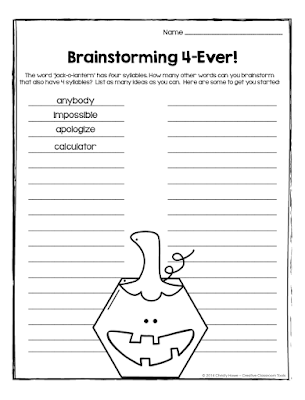
First up on the board is "Brainstorming 4-Ever!" This was originally a printable activity I used as an anchor activity with my little Einsteins. This year, I decided to make the activity larger than life to "hook" and motivate my students in a new way.

Using the word "Jack-o-lantern" as inspiration, this Halloween-themed activity challenges students to think of as many different 4-syllable words as they can. Avocado, comprehension, impossible, articulate . . . the possibilities are endless, but it is delightfully difficult!

To add a level of difficulty, eliminate proper nouns. OR, make it a game! After brainstorming a list of words, students compare answers with other players. Students earn one point for each unique response that no other player has. The player with the most points wins. This can be timed or un-timed.

When students arrive to class early, finish assignments early, are in need of enrichment, or just want to be inspired, they grab a brainstorming sheet from the envelope. I've included a printable copy of the activity below in case you'd like to try it out with your kiddos. :-)

You can find the whole pack of activities here.

Next up, is Halloween math:


This too was a printable activity that I enlarged for a new twist. Each Halloween symbol represents a number. Students can "Guess and Check" or use algebra to reach the correct answer. There is something about a larger than life math problem that kids love! I'm not sure if it's the novelty of the presentation or the seasonal images, but they are in love. You can find the printable version of this activity (along with the answer :-) here.

And last, but not least, is 24 - an all-time student favorite.


In the game of 24, students use the four numbers given once and only once along with a combination of operations to reach 24. Students record their answer on the recording sheet below. You can find a free copy here. (It's nothing fancy, but it's one less thing to make :-)


24 is so easy to prep and offers meaningful, fun, differentiated math practice. If you'd like to learn more, you can check out my earlier post here.

Thanks for checking in! If you have any thoughts or questions, let me know; I'd love to hear from you!

creative thinking

Creative Writing Prompts - For Kids of ALL Ages!

Friday, January 02, 2015


Fun and engaging creative writing prompts for kids. Mix and Match Picture Prompts provide visual inspiration and scaffolding to inspire even your most reluctant writers. A free sample printable is included for you to try!

I wanted a new writing "hook" to motivate and engage my 3-5 students in the new year. Even though the majority of my students are identified as academically and/or intellectually gifted, I still have some very, (and I mean VERY), reluctant writers.

So, here's my thought . . . pictures! A picture is worth a thousand words, right? So, I created a series of visual writing prompts to engage my little learners. Each writing prompt includes 4-6 pictures with purposefully open-ended labels, such as "a science experiment," "an explosion," "an unexpected outcome," and "a bewildered student." Students combine the 4-6 elements to craft an original story. Simple, easy, and engaging. And the best part - the activity is naturally differentiated. Writers at all levels can access and interact with the prompts in the way that is most appropriate for their unique strengths and abilities.


Fun and engaging creative writing prompts for kids. Mix and Match Picture Prompts provide visual inspiration and scaffolding to inspire even your most reluctant writers. A free sample printable is included for you to try!


My hope is that these visual prompts will not only motivate my students, but also help to scaffold and support the writing process. It is also an opportunity for students to look at familiar objects and events in new ways (aka: a forced association). A forced association asks students to find similarities among items/ideas that are seemingly unrelated. By combining words that appear to be dissimilar, students are encouraged to think in new ways and to develop new perspectives and understandings. Forced associations are a great way to promote critical and creative thinking. (You can read more about forced associations here.)


Fun and engaging creative writing prompts for kids. Mix and Match Picture Prompts provide visual inspiration and scaffolding to inspire even your most reluctant writers. A free sample printable is included for you to try!


I designed the Mix and Match writing prompts in two different formats to have some flexibility with implementation. My first thought was printable pages for "Work on Writing" centers/stations, anchor activities, and independent work. I then also put each prompt in the form of a task card so that students could glue the prompt into their writing notebook.


Fun and engaging creative writing prompts for kids. Mix and Match Picture Prompts provide visual inspiration and scaffolding to inspire even your most reluctant writers. A free sample printable is included for you to try!


Want to try it out with me? If so, you can download one of the sixteen 8.5 x 11" printable pages below for FREE here.  To see the entire pack, click here.
Fun and engaging creative writing prompts for kids. Mix and Match Picture Prompts provide visual inspiration and scaffolding to inspire even your most reluctant writers. A free sample printable is included for you to try!

What kinds of writing prompts do you use with your students? Leave a comment and let me know; I'd love to learn with you!

1st grade

Animal Soup: A divergent thinking activity for K-2

Friday, November 28, 2014


Need a fun divergent thinking activity to inspire and engage your K-2 students? Try making animal soup! This post includes free printables and implementation ideas to make creativity in the classroom a breeze!

Hi All! I am checking in today to share one of my favorite K-2 activities - Animal Soup! Animal Soup, by Paul Doodler, is a short, lift-the-flap book that combines everyday animals to create silly outcomes.

Need a fun divergent thinking activity to inspire and engage your K-2 students? Try making animal soup! This post includes free printables and implementation ideas to make creativity in the classroom a breeze!

Let's check out how it works! Below are two sample pages from the book. After considering the question, students can lift the flap to see the 3rd page. Give it a try:

What would you be if you had wings to fly like a bird . . .

Need a fun divergent thinking activity to inspire and engage your K-2 students? Try making animal soup! This post includes free printables and implementation ideas to make creativity in the classroom a breeze!

and walked slowly like a turtle?

Need a fun divergent thinking activity to inspire and engage your K-2 students? Try making animal soup! This post includes free printables and implementation ideas to make creativity in the classroom a breeze!

A BiRdLe! 

Need a fun divergent thinking activity to inspire and engage your K-2 students? Try making animal soup! This post includes free printables and implementation ideas to make creativity in the classroom a breeze!


Seriously, this book cracks me up every year! My favorite combination is the flamingo and monkey. (A flamonkey :-)

Once we read the story as a class, I give students the task of creating their own animal. Each student selects two animal cards. (I cut the cards and put them in a "magic box" prior to the lesson. Students randomly select their animals from the magic box; it makes the selection of the animals for their soup a little dramatic and a lot of fun!)
Need a fun divergent thinking activity to inspire and engage your K-2 students? Try making animal soup! This post includes free printables and implementation ideas to make creativity in the classroom a breeze!

Students then glue the cards to the activity sheet below.

Need a fun divergent thinking activity to inspire and engage your K-2 students? Try making animal soup! This post includes free printables and implementation ideas to make creativity in the classroom a breeze!download here for free


From here, students combine elements of each animal's name to create a new animal species. Some examples might include:

  • alligator + gorilla = gorillagator
  • lion + dinosaur = linosaur
  • monkey + kangaroo = monkaroo
  • puppy + hippopotamus = puppyotamus
Because the goal is to develop divergent thinking skills, I frequently remind students that there is more than one correct answer. For example, if you were part alligator and part octopus, you could be an allipus, an octigator, or a gatorpus. The possibilities are endless.

Then they draw a picture to illustrate their animal soup creation. Here are a few examples from one of my first grade nurturing lessons:

Need a fun divergent thinking activity to inspire and engage your K-2 students? Try making animal soup! This post includes free printables and implementation ideas to make creativity in the classroom a breeze!


Need a fun divergent thinking activity to inspire and engage your K-2 students? Try making animal soup! This post includes free printables and implementation ideas to make creativity in the classroom a breeze!


Need a fun divergent thinking activity to inspire and engage your K-2 students? Try making animal soup! This post includes free printables and implementation ideas to make creativity in the classroom a breeze!


Oftentimes, I compile the student pictures and make it into a class book. Most times, the kids are too eager to take them home right away to share :-)

You can download the activity sheet and animal cards for FREE here.
Need a fun divergent thinking activity to inspire and engage your K-2 students? Try making animal soup! This post includes free printables and implementation ideas to make creativity in the classroom a breeze!


To learn more about fun ways to nurture creative thinking in the classroom, check out two of my earlier posts: Let's Get Creative and Creativity in the Classroom. Thanks for checking in!

brain food

Creativity in the Classroom

Friday, August 01, 2014

6 easy ways to nurture creativity in the classroom! Simple ideas and inspiration for any classroom.


Creativity is a skill, just like reading or math, that can be taught and learned. No kidding!! :-) Through exposure, experience, and practice, creative thinking is a skill anyone can cultivate.

Not only is creative thinking FUN, but it is also important! Divergent thinking increases a student’s desire to learn and supports his/her intellectual development. When we encourage creative thinking, we promote student engagement, motivation, and love for learning.

My first post in this series, "Let's Get Creative," addressed the 4-Framework model of creativity and shared easy, low or no-prep activities to use in the classroom. You can read more about that here, if you like. This post will focus on ways to develop a culture of creativity in the classroom.


6 easy ways to nurture creativity in the classroom! Simple ideas and inspiration for any classroom.


1. Accept and celebrate all of the ideas that students offer – even the ones that are wacky or off the wall! When brainstorming, the goal is quantity, not quality. Generating ideas is the first step in effective problem solving! Students can always revisit their ideas later and decide which ones are worth keeping.


6 easy ways to nurture creativity in the classroom! Simple ideas and inspiration for any classroom.

2. Encourage “piggybacking” or building on the ideas of others. Creative thinking does not exist in a vacuum. People learn from and thrive on the inspiration and ideas of others. Encourage students – not to copy – but to build on, develop, and extend the ideas of their peers.


6 easy ways to nurture creativity in the classroom! Simple ideas and inspiration for any classroom.

3. Model it! Creative thinking is a skill that can be learned! Just as we would provide instruction and support to help our students understand fractions or physics, we need to do the same for creative thinking. Our students have tremendous creative capacity and it is our job to help them identify and develop it. One of my favorite ways to model creative thought is described in tip #5; students often learn best from their peers.


6 easy ways to nurture creativity in the classroom! Simple ideas and inspiration for any classroom.


4. Creativity takes time, so give students time to think, try out new ideas, and invent. Creativity can be integrated throughout the academic day with strategies like open-ended questions, project based learning, and student choice. I also like to specifically carve out time in our day to focus on creative thinking. Because the school day is so jam-packed, and much of our instructional time is mandated by others, I tend to use creative activities, like "Brain Food," as:
  • Bell Ringers: My students can arrive anytime between 7:30 and 8:00. This 30 minutes can pose a challenge! While I want morning work activities to be worthwhile, I don’t want students who arrive at 8:00 to be “penalized” for missing this time. I love using creativity exercises as bell ringers because my students who are present are meaningfully engaged and developing essential skills, but it does not put other students “behind.” 
  • Center Activities: I often have a “Creation Station” as one of my center rotations in both math and reading. Divergent thinking activities are perfect for this spot! Students can tackle the tasks with independence AND at their individual level of readiness. 
  • Anchor Activities: Creative thinking activities are a great resource for my fast finishers! I give each student a “Brain Food” packet and if they finish early, they can pull it out and be actively engaged. 
There are other fun, meaningful ways to incorporate creative enrichment into the school day, but these are a few of my favorites.


6 easy ways to nurture creativity in the classroom! Simple ideas and inspiration for any classroom.


5. Make time to share! Not only do students love to share their original creations, but it also supports and promotes further creative thought. Seeing other ideas and perspectives can help students to approach their own work in different ways. In addition, students are more likely to be purposefully engaged and challenge themselves if they know their work will have an audience.


6 easy ways to nurture creativity in the classroom! Simple ideas and inspiration for any classroom.


6. Create a safe environment that encourages students to take creative risks. Creative thinking needs to be shared and validated by others in a supportive atmosphere. Nothing squashes enthusiasm and a willingness to try like negative remarks and criticism.

Here are some thoughts to get you started! Let me know what questions you have; I'd love to hear from you. Thanks for checking in!

brain food

Let's Get Creative!

Tuesday, July 15, 2014

I am all about creativity in the classroom! (Who isn't? Creativity rocks, right?) I've always known that creativity is an art, but I've learned that it is also a science. In fact creativity is a skill, just like reading or math, that can be taught and learned. Yes, for real!! :-) Through exposure, experience, and practice, creative thinking is a skill anyone can cultivate.

Did you know that creativity is a skill that can be taught, just like reading and math? Yes, for real! This post offers ideas, activities, and inspiration for building creative thinking and creative thinkers in your classroom.

According to Paul Torrance, (who is often referred to as the "Father of Creativity"), creative thinking can be quantified. He broke it into a 4-part framework, which includes fluency, flexibility, originality, and elaboration. I love this framework because it gives me a scaffold with which to promote, support, and nurture creativity in my students, myself, and my class.

Did you know that creativity is a skill that can be taught, just like reading and math? Yes, for real! This post offers ideas, activities, and inspiration for building creative thinking and creative thinkers in your classroom.


This post, which is the first in a series on creativity, briefly describes the 4-part framework and suggests quick, easy activities you can do with your class to promote creative and critical thinking everyday. So, here we go!

1. FLUENCY:
Fluency is the act of generating many different ideas. This is an essential component of, and often the first step in, the problem solving process. Fluency encourages us to consider a variety of options and, with more options, we are more likely to reach a successful solution.


With fluency, quantity is more important than quality. Accept all ideas that students offer – even the ones that are wacky or off the wall! Students can revisit their list of ideas later to reflect on their responses and decide which ideas are worth keeping.

Brainstorming is a wonderful way to encourage fluency of thought. As a daily warm-up, center activity, or even while you're waiting in line for lunch with your students, pose one of the following questions:

Name things that:
  • are hot
  • are old
  • are sour
  • take less than a minute
  • are big, but not heavy
  • change over time
  • go up and down
  • are better to do fast instead of slow

Another way to promote fluency is through pictures. Present your students with an image and ask them to write a caption or generate alternate uses. Below is an example of writing captions using an everyday icon from Ian Byrdseed's amazing website:


sample captions:
  • "Another juggler gives up on his dreams."
  • "Jack decides to ditch the beans and move to Europe."

Alternate uses for an everyday item, such as a pencil, might be: a drum stick, a back-scratcher, a catapult, chopsticks, etc.


2. FLEXIBILITY:
Flexibility is the ability to produce ideas from different categories, perspectives, and points of view. Flexible thinking encourages us to see one thing in many different ways.


Below are some ways to see usual things in unusual ways and from different points of view.

Forced Associations: A forced association asks students to find similarities among items/ideas that are seemingly unrelated. By combining words that appear to be dissimilar, students are encouraged to think in new ways and to develop new perspectives and understandings. Try these with your class!

How is . . .
  • a teacher like a chair
  • a window like a pair of glasses
  • the earth like a fishbowl
  • number like a letter
Pictures are another great way to promote flexibility. I love these image that I found on SlowRobot.com:


What a great example of using "normal," everyday items to create new things! You can find more ideas for forced associations (and no-prep printables) here.


3. ORIGINALITY:
Originality is the ability to produce ideas that are unique or original. This creativity tool involves synthesis or putting information together in a new way. Scattergories was one of my favorite games growing up; it was not until I was an adult that I figured out how fabulous it is for developing originality! To play, each student generates an item or items for each category. A point is earned for each idea that no one else has. Check out the example below:


Did you know that creativity is a skill that can be taught, just like reading and math? Yes, for real! This post offers ideas, activities, and inspiration for building creative thinking and creative thinkers in your classroom.


4. ELABORATION:
Elaboration is the ability to enhance ideas by providing information and detail. Elaboration can make basic ideas, answers, or pictures interesting and exciting.

For example: provide students with a basic shape, squiggle, or mark on the page. Tell students that this picture is unfinished and that they should brainstorm a list of all the different things it could be. Students should select their favorite idea and then add details to elaborate, enhance, and improve. Here's an example from my Spring Enrichment Packet:


If you liked this post, you may be interested in some of the activities below. 


Did you know that creativity is a skill that can be taught, just like reading and math? Yes, for real! This post offers ideas, activities, and inspiration for building creative thinking and creative thinkers in your classroom.       
                                      Brain Food                                  "Back to School" Brain Food


Did you know that creativity is a skill that can be taught, just like reading and math? Yes, for real! This post offers ideas, activities, and inspiration for building creative thinking and creative thinkers in your classroom.
                   Picture Prompts for Creative Writing        Squiggle Stories: Creative Writing Prompts


I hope you'll check back for the next part of the creativity series! In the meantime:
How do you promote creative thought in your classroom?  What else do you want to learn or know about creativity?  I'd love to hear from you!

Popular Posts

Search This Blog

 photo 3AM_RoundLogo_2014_zps9a7b6078.png
Custom Graphics & Blog Design © 2017 The 3AM Teacher All Rights Reserved