4th grade

Building A Classroom Community

Saturday, September 13, 2014

Build a positive classroom community with these easy, hands-on activities and games.  They are great for back to school or any time your students need a focus on class or team building.


We had another great week in our new classroom! This week, we focused on building classroom community. Our first activities addressed team building and communication - specifically respectful listening and speaking. Below you can see pictures from the "Paper Tower Tournament." In this challenge, students collaborated in randomly selected groups to build a tower made of printer paper. The goal is to create the tallest, free-standing tower using only 3 sheets of paper and 12 inches of masking tape. No additional materials or supports can be used.

Build a positive classroom community with these easy, hands-on activities and games.  They are great for back to school or any time your students need a focus on class or team building.


After 10-15 minutes of team work, we paused to reflect. Using our Guidelines for Team Work Rubric, we evaluated our behaviors, considering areas of strength and places for growth.

Build a positive classroom community with these easy, hands-on activities and games.  They are great for back to school or any time your students need a focus on class or team building.Build a positive classroom community with these easy, hands-on activities and games.  They are great for back to school or any time your students need a focus on class or team building.

You can find the guidelines and rubric here.


After setting personal goals, we were back to work.

Build a positive classroom community with these easy, hands-on activities and games.  They are great for back to school or any time your students need a focus on class or team building.

At the end of the contest, we celebrated our many successes! Awards were given for the tallest, most unique, best design, and most creative use of materials. We then had a really great group discussion about what went well, what felt hard, and things we might do differently when working in a team - and on difficult tasks - in the future.

Our next challenge posed the same goal: build the tallest, free-standing tower. However, this time, the materials included dry spaghetti and mini-marshmallows. Once again, teams were randomly selected to encourage students to work with, enjoy, and appreciate the styles of different peers.

Build a positive classroom community with these easy, hands-on activities and games.  They are great for back to school or any time your students need a focus on class or team building.


Again we used the rubric at the beginning, half way through, and at the end to set goals and reflect.


Build a positive classroom community with these easy, hands-on activities and games.  They are great for back to school or any time your students need a focus on class or team building.


Students were intrigued that their personal goals and reflections often changed based on the team with which they worked!


Build a positive classroom community with these easy, hands-on activities and games.  They are great for back to school or any time your students need a focus on class or team building.


We had another very thoughtful post-discussion. Again students considered what went well, what areas were challenging, and appropriate goals for the future. (We are always trying to Be More Awesome, right? :-)

Our final community building challenge of this week was based on a free set of dice from Chik-fil-A. For real! (Inspiration comes from many places! Thank you, Tara Mulvey!) Each side of the die had a theme: fame, family, best, worst, most embarrassing, etc. Under each theme was a series of questions to help us learn more about each other. Even though many of my 4th and 5th graders have been together since Kindergarten, I think it is important for students to not only know each other, but to feel "known." This helps to create a safe environment where children can try new things, take risks, make mistakes, and be themselves - all critical building blocks to success.

Build a positive classroom community with these easy, hands-on activities and games.  They are great for back to school or any time your students need a focus on class or team building.

I typed up the questions on cardstock and, using a modified version of Kagan's Cooperative Grouping Strategy "Fan, Pick, Read, Answer," we set out to learn more about one another. (Again, with the goals of respectful listening and speaking in mind!) Students, again worked in randomly selected teams to promote understanding, friendship, and respect.


Build a positive classroom community with these easy, hands-on activities and games.  They are great for back to school or any time your students need a focus on class or team building.

Questions/prompts included:

  • Tell about a time you laughed so hard you could not stop.
  • Describe the worst hair cut you've ever had.
  • Have you ever had to speak or perform in front of an audience? How did it make you feel?
  • Tell about something you did that made you feel proud.
Next week we will begin Math Quest, a dystopian book study, and Problem Based Learning. Stay tuned!

4th grade

Be More Awesome!

Sunday, September 07, 2014

With inspiration from Kid President, students set goals to "Be More Awesome!" Read on to learn ideas for implementation and grab a free printable activity! Put completed student pennants together to create a classroom banner. Perfect décor all year long!


My 4th and 5th grade gifted students began pull-out classes this week. Our first order of business was to set goals for the new school year. We began with a pep talk from Kid President, who inspires us to learn, teach, change the world, and BE MORE AWESOME!


With inspiration from Kid President, students set goals to "Be More Awesome!" Read on to learn ideas for implementation and grab a free printable activity! Put completed student pennants together to create a classroom banner. Perfect décor all year long!

After watching Kid President, we examined some of the ways we are awesome. As you can imagine, many pieces of paper were needed. :-) We then looked at ways we could be "more awesome." I shared my personal goals for a more awesome year with the students and modeled how I tried to create goals that were meaningful, specific, relevant, and realistic. (Not exactly "SMART" goals, but in the same spirit.) Using a "Be More Awesome" pennant, each student brainstormed goals for the first nine weeks.

With inspiration from Kid President, students set goals to "Be More Awesome!" Read on to learn ideas for implementation and grab a free printable activity! Put completed student pennants together to create a classroom banner. Perfect décor all year long!


With inspiration from Kid President, students set goals to "Be More Awesome!" Read on to learn ideas for implementation and grab a free printable activity! Put completed student pennants together to create a classroom banner. Perfect décor all year long!


With inspiration from Kid President, students set goals to "Be More Awesome!" Read on to learn ideas for implementation and grab a free printable activity! Put completed student pennants together to create a classroom banner. Perfect décor all year long!


With inspiration from Kid President, students set goals to "Be More Awesome!" Read on to learn ideas for implementation and grab a free printable activity! Put completed student pennants together to create a classroom banner. Perfect décor all year long!


Our completed goals are on display in the classroom.


With inspiration from Kid President, students set goals to "Be More Awesome!" Read on to learn ideas for implementation and grab a free printable activity! Put completed student pennants together to create a classroom banner. Perfect décor all year long!


With inspiration from Kid President, students set goals to "Be More Awesome!" Read on to learn ideas for implementation and grab a free printable activity! Put completed student pennants together to create a classroom banner. Perfect décor all year long!


For those of you who would like to try this out with your AWESOME class, you can find a free copy of the banner here.

With inspiration from Kid President, students set goals to "Be More Awesome!" Read on to learn ideas for implementation and grab a free printable activity! Put completed student pennants together to create a classroom banner. Perfect décor all year long!With inspiration from Kid President, students set goals to "Be More Awesome!" Read on to learn ideas for implementation and grab a free printable activity! Put completed student pennants together to create a classroom banner. Perfect décor all year long!


Thanks for checking in! I hope your first few weeks of school have been awesome!

brain food

Creativity in the Classroom

Friday, August 01, 2014

6 easy ways to nurture creativity in the classroom! Simple ideas and inspiration for any classroom.


Creativity is a skill, just like reading or math, that can be taught and learned. No kidding!! :-) Through exposure, experience, and practice, creative thinking is a skill anyone can cultivate.

Not only is creative thinking FUN, but it is also important! Divergent thinking increases a student’s desire to learn and supports his/her intellectual development. When we encourage creative thinking, we promote student engagement, motivation, and love for learning.

My first post in this series, "Let's Get Creative," addressed the 4-Framework model of creativity and shared easy, low or no-prep activities to use in the classroom. You can read more about that here, if you like. This post will focus on ways to develop a culture of creativity in the classroom.


6 easy ways to nurture creativity in the classroom! Simple ideas and inspiration for any classroom.


1. Accept and celebrate all of the ideas that students offer – even the ones that are wacky or off the wall! When brainstorming, the goal is quantity, not quality. Generating ideas is the first step in effective problem solving! Students can always revisit their ideas later and decide which ones are worth keeping.


6 easy ways to nurture creativity in the classroom! Simple ideas and inspiration for any classroom.

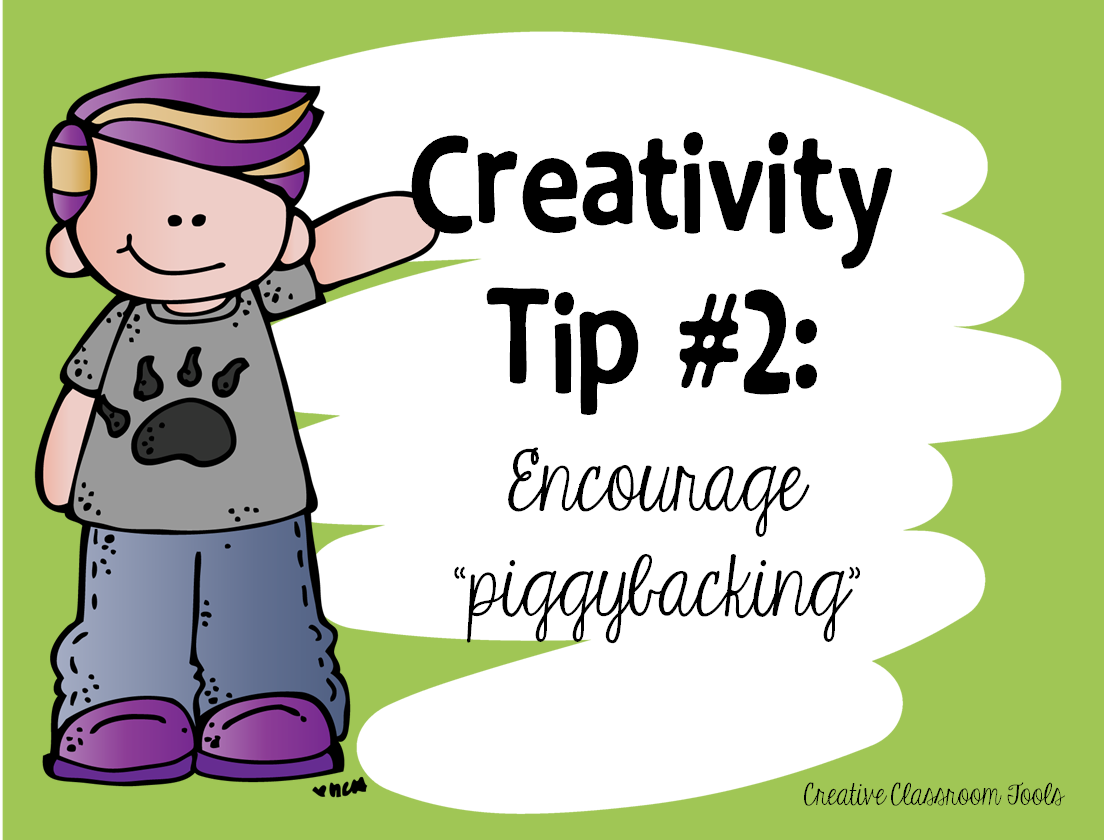
2. Encourage “piggybacking” or building on the ideas of others. Creative thinking does not exist in a vacuum. People learn from and thrive on the inspiration and ideas of others. Encourage students – not to copy – but to build on, develop, and extend the ideas of their peers.


6 easy ways to nurture creativity in the classroom! Simple ideas and inspiration for any classroom.

3. Model it! Creative thinking is a skill that can be learned! Just as we would provide instruction and support to help our students understand fractions or physics, we need to do the same for creative thinking. Our students have tremendous creative capacity and it is our job to help them identify and develop it. One of my favorite ways to model creative thought is described in tip #5; students often learn best from their peers.


6 easy ways to nurture creativity in the classroom! Simple ideas and inspiration for any classroom.


4. Creativity takes time, so give students time to think, try out new ideas, and invent. Creativity can be integrated throughout the academic day with strategies like open-ended questions, project based learning, and student choice. I also like to specifically carve out time in our day to focus on creative thinking. Because the school day is so jam-packed, and much of our instructional time is mandated by others, I tend to use creative activities, like "Brain Food," as:
  • Bell Ringers: My students can arrive anytime between 7:30 and 8:00. This 30 minutes can pose a challenge! While I want morning work activities to be worthwhile, I don’t want students who arrive at 8:00 to be “penalized” for missing this time. I love using creativity exercises as bell ringers because my students who are present are meaningfully engaged and developing essential skills, but it does not put other students “behind.” 
  • Center Activities: I often have a “Creation Station” as one of my center rotations in both math and reading. Divergent thinking activities are perfect for this spot! Students can tackle the tasks with independence AND at their individual level of readiness. 
  • Anchor Activities: Creative thinking activities are a great resource for my fast finishers! I give each student a “Brain Food” packet and if they finish early, they can pull it out and be actively engaged. 
There are other fun, meaningful ways to incorporate creative enrichment into the school day, but these are a few of my favorites.


6 easy ways to nurture creativity in the classroom! Simple ideas and inspiration for any classroom.


5. Make time to share! Not only do students love to share their original creations, but it also supports and promotes further creative thought. Seeing other ideas and perspectives can help students to approach their own work in different ways. In addition, students are more likely to be purposefully engaged and challenge themselves if they know their work will have an audience.


6 easy ways to nurture creativity in the classroom! Simple ideas and inspiration for any classroom.


6. Create a safe environment that encourages students to take creative risks. Creative thinking needs to be shared and validated by others in a supportive atmosphere. Nothing squashes enthusiasm and a willingness to try like negative remarks and criticism.

Here are some thoughts to get you started! Let me know what questions you have; I'd love to hear from you. Thanks for checking in!

brain food

Let's Get Creative!

Tuesday, July 15, 2014

I am all about creativity in the classroom! (Who isn't? Creativity rocks, right?) I've always known that creativity is an art, but I've learned that it is also a science. In fact creativity is a skill, just like reading or math, that can be taught and learned. Yes, for real!! :-) Through exposure, experience, and practice, creative thinking is a skill anyone can cultivate.

Did you know that creativity is a skill that can be taught, just like reading and math? Yes, for real! This post offers ideas, activities, and inspiration for building creative thinking and creative thinkers in your classroom.

According to Paul Torrance, (who is often referred to as the "Father of Creativity"), creative thinking can be quantified. He broke it into a 4-part framework, which includes fluency, flexibility, originality, and elaboration. I love this framework because it gives me a scaffold with which to promote, support, and nurture creativity in my students, myself, and my class.

Did you know that creativity is a skill that can be taught, just like reading and math? Yes, for real! This post offers ideas, activities, and inspiration for building creative thinking and creative thinkers in your classroom.


This post, which is the first in a series on creativity, briefly describes the 4-part framework and suggests quick, easy activities you can do with your class to promote creative and critical thinking everyday. So, here we go!

1. FLUENCY:
Fluency is the act of generating many different ideas. This is an essential component of, and often the first step in, the problem solving process. Fluency encourages us to consider a variety of options and, with more options, we are more likely to reach a successful solution.


With fluency, quantity is more important than quality. Accept all ideas that students offer – even the ones that are wacky or off the wall! Students can revisit their list of ideas later to reflect on their responses and decide which ideas are worth keeping.

Brainstorming is a wonderful way to encourage fluency of thought. As a daily warm-up, center activity, or even while you're waiting in line for lunch with your students, pose one of the following questions:

Name things that:
  • are hot
  • are old
  • are sour
  • take less than a minute
  • are big, but not heavy
  • change over time
  • go up and down
  • are better to do fast instead of slow

Another way to promote fluency is through pictures. Present your students with an image and ask them to write a caption or generate alternate uses. Below is an example of writing captions using an everyday icon from Ian Byrdseed's amazing website:


sample captions:
  • "Another juggler gives up on his dreams."
  • "Jack decides to ditch the beans and move to Europe."

Alternate uses for an everyday item, such as a pencil, might be: a drum stick, a back-scratcher, a catapult, chopsticks, etc.


2. FLEXIBILITY:
Flexibility is the ability to produce ideas from different categories, perspectives, and points of view. Flexible thinking encourages us to see one thing in many different ways.


Below are some ways to see usual things in unusual ways and from different points of view.

Forced Associations: A forced association asks students to find similarities among items/ideas that are seemingly unrelated. By combining words that appear to be dissimilar, students are encouraged to think in new ways and to develop new perspectives and understandings. Try these with your class!

How is . . .
  • a teacher like a chair
  • a window like a pair of glasses
  • the earth like a fishbowl
  • number like a letter
Pictures are another great way to promote flexibility. I love these image that I found on SlowRobot.com:


What a great example of using "normal," everyday items to create new things! You can find more ideas for forced associations (and no-prep printables) here.


3. ORIGINALITY:
Originality is the ability to produce ideas that are unique or original. This creativity tool involves synthesis or putting information together in a new way. Scattergories was one of my favorite games growing up; it was not until I was an adult that I figured out how fabulous it is for developing originality! To play, each student generates an item or items for each category. A point is earned for each idea that no one else has. Check out the example below:


Did you know that creativity is a skill that can be taught, just like reading and math? Yes, for real! This post offers ideas, activities, and inspiration for building creative thinking and creative thinkers in your classroom.


4. ELABORATION:
Elaboration is the ability to enhance ideas by providing information and detail. Elaboration can make basic ideas, answers, or pictures interesting and exciting.

For example: provide students with a basic shape, squiggle, or mark on the page. Tell students that this picture is unfinished and that they should brainstorm a list of all the different things it could be. Students should select their favorite idea and then add details to elaborate, enhance, and improve. Here's an example from my Spring Enrichment Packet:


If you liked this post, you may be interested in some of the activities below. 


Did you know that creativity is a skill that can be taught, just like reading and math? Yes, for real! This post offers ideas, activities, and inspiration for building creative thinking and creative thinkers in your classroom.       
                                      Brain Food                                  "Back to School" Brain Food


Did you know that creativity is a skill that can be taught, just like reading and math? Yes, for real! This post offers ideas, activities, and inspiration for building creative thinking and creative thinkers in your classroom.
                   Picture Prompts for Creative Writing        Squiggle Stories: Creative Writing Prompts


I hope you'll check back for the next part of the creativity series! In the meantime:
How do you promote creative thought in your classroom?  What else do you want to learn or know about creativity?  I'd love to hear from you!

Popular Posts

Search This Blog

 photo 3AM_RoundLogo_2014_zps9a7b6078.png
Custom Graphics & Blog Design © 2017 The 3AM Teacher All Rights Reserved